
The Most Tested Essay Type in Middle School 미국 중학교에서 가장 자주 출제되는 에세이 유형
If your child is in grades 5 through 7, there is one type of essay they will encounter over and over again — in English class, in social studies, in science, and on standardized tests. That essay is the argumentative essay. It is not optional. It is not a once-a-year assignment. It is the backbone of academic writing at this level, and students who do not understand its structure will consistently lose points without knowing why.
자녀가 5학년에서 7학년 사이라면, 영어 수업, 사회, 과학, 그리고 각종 시험에서 반복해서 마주치게 되는 에세이 유형이 있습니다. 바로 argumentative essay입니다. 선택이 아닙니다. 일 년에 한 번 나오는 과제도 아닙니다. 이 학년대 아카데믹 라이팅의 핵심이며, 구조를 제대로 이해하지 못한 학생들은 왜 점수가 깎이는지도 모른 채 계속 잃게 됩니다.
The Common Core State Standards — which most U.S. public schools follow — formally introduce argument writing in 6th grade and build on it every single year through high school. NY State ELA exams, PARCC, and SBAC all include argument-based writing tasks. Even science and history teachers increasingly ask students to “take a position and support it with evidence.” This is not a trend. This is the standard.
미국 대부분의 공립학교가 따르는 Common Core State Standards는 6학년부터 argument writing을 공식적으로 도입하고, 고등학교까지 매년 심화시킵니다. NY State ELA 시험, PARCC, SBAC 모두 논증 기반 글쓰기 문제를 포함합니다. 심지어 과학, 사회 선생님들도 점점 더 “입장을 정하고 근거로 뒷받침하라”고 요구합니다. 이건 트렌드가 아닙니다. 이것이 기준입니다.
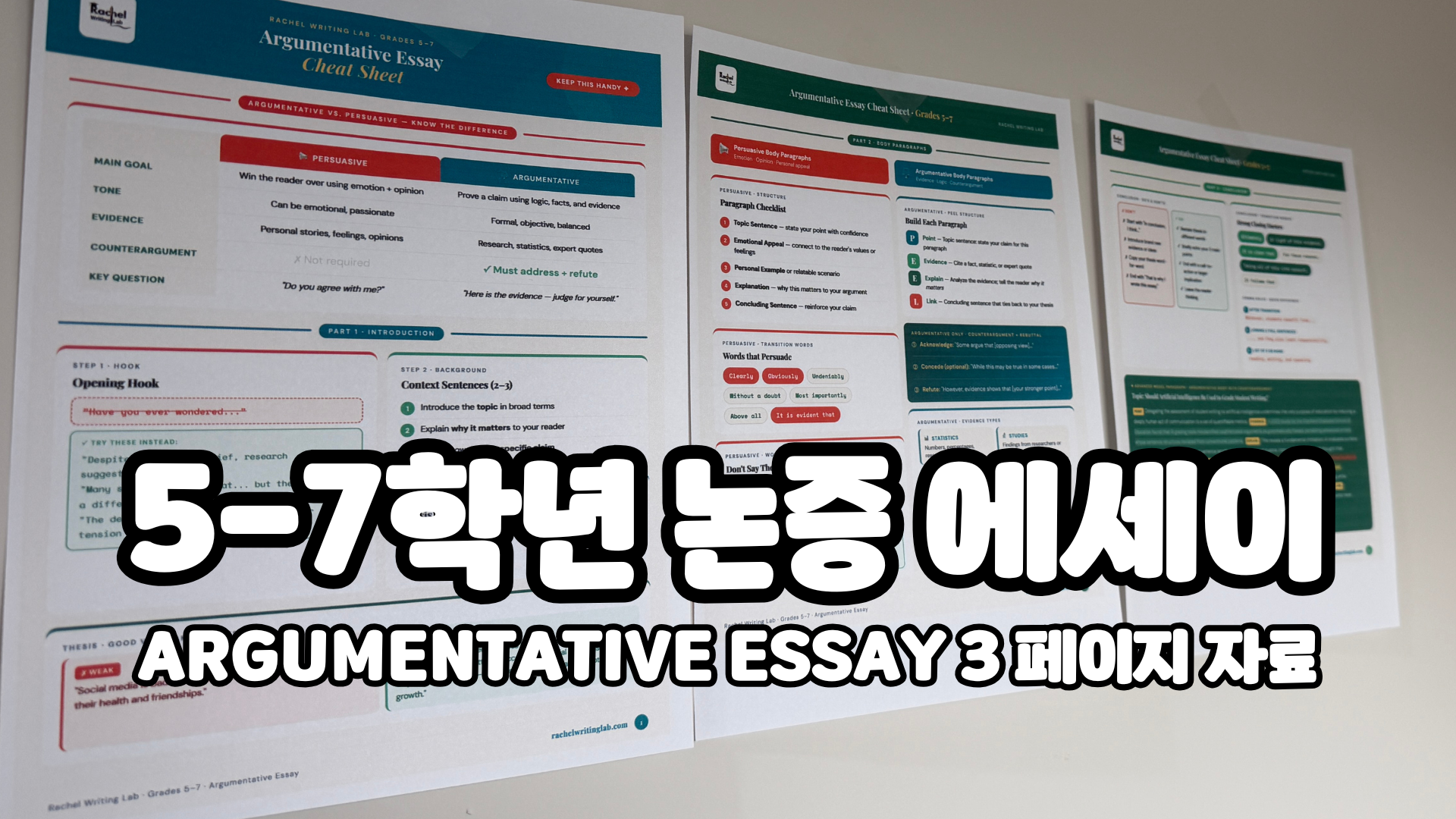
That is exactly why I created this 3-page Argumentative Essay Cheat Sheet — a resource designed for grades 5–7 students to understand the fundamentals, avoid the most common mistakes, and walk into any essay assignment with confidence.
바로 그 이유로 이 3페이지짜리 Argumentative Essay Cheat Sheet를 만들었습니다. 5~7학년 학생들이 기본기를 이해하고, 가장 흔한 실수를 피하고, 어떤 에세이 과제에도 자신 있게 임할 수 있도록 설계된 자료입니다.

Argumentative vs. Persuasive — They Are NOT the Same Thing Argumentative vs. Persuasive — 이 둘은 같지 않습니다
This is one of the most common points of confusion I see — and it costs students points. Many students (and honestly, many parents too) assume that argumentative and persuasive essays are just two words for the same thing. They are not.
이것이 제가 가장 자주 보는 혼동 포인트 중 하나이고, 실제로 점수에 영향을 미칩니다. 많은 학생들이 (그리고 솔직히 많은 부모님들도) argumentative와 persuasive 에세이가 같은 것을 부르는 두 가지 이름이라고 생각합니다. 그렇지 않습니다.
A persuasive essay is designed to win the reader over. It leans on emotion, personal opinion, and passionate language. The goal is to make the reader feel something — to agree with you. A persuasive essay does not need to acknowledge the other side. You simply make your case as strongly as possible.
Persuasive essay는 독자를 설득하기 위해 설계됩니다. 감정, 개인적인 의견, 열정적인 언어에 의존합니다. 목표는 독자가 무언가를 느끼게 만드는 것 — 당신에게 동의하게 만드는 것입니다. Persuasive essay는 반대 의견을 다룰 필요가 없습니다. 그냥 자신의 주장을 최대한 강하게 펼치면 됩니다.
An argumentative essay operates differently. The goal is not to make the reader feel — it is to make the reader think. It requires formal, objective language. It requires real evidence: statistics, research findings, expert quotes, historical examples. And most importantly, it requires a counterargument — the student must acknowledge the opposing view and then refute it. This is what separates a middle school argumentative essay from everything students wrote in elementary school.
Argumentative essay는 다르게 작동합니다. 목표는 독자가 느끼게 만드는 것이 아니라 생각하게 만드는 것입니다. 격식 있고 객관적인 언어가 필요합니다. 실제 근거가 필요합니다: 통계, 연구 결과, 전문가 인용, 역사적 사례. 그리고 가장 중요한 것은 counterargument가 필요하다는 점입니다 — 학생은 반대 의견을 인정한 다음 그것을 반박해야 합니다. 이것이 중학교 argumentative essay를 초등학교에서 쓴 모든 글과 구분 짓는 요소입니다.
A simple way to remember the difference: a persuasive essay asks “Do you agree with me?” An argumentative essay says “Here is the evidence — think for yourself.”
차이를 기억하는 간단한 방법: persuasive essay는 “제 말에 동의하시나요?”라고 묻습니다. Argumentative essay는 “여기 근거가 있습니다 — 스스로 판단하세요”라고 말합니다.
Part 1: The Introduction — Where Most Students Fall Apart Part 1: 서론 — 대부분의 학생들이 무너지는 곳
The introduction has three jobs: hook the reader, provide context, and state the thesis. Students who skip or rush any one of these three steps lose points immediately — before the teacher has even read the body of the essay.
서론에는 세 가지 역할이 있습니다: 독자를 끌어당기고, 배경을 제공하고, thesis를 제시하는 것. 이 세 단계 중 하나라도 건너뛰거나 서두르는 학생들은 선생님이 본론을 읽기도 전에 즉시 점수를 잃습니다.
The Hook. The first sentence of any essay sets the tone for everything that follows. Yet this is where I see the most avoidable mistake: students opening with “Have you ever wondered…” This type of question hook is so overused that teachers have largely stopped giving credit for it. It signals that the student does not know how to start — so they grabbed the easiest option. Instead, students should open with a bold statement, a surprising fact, or a sentence that immediately establishes the tension their essay will address. For example: “Despite widespread belief, research suggests that more homework does not lead to better grades — it leads to burnout.”
Hook(도입부 문장). 에세이의 첫 번째 문장은 이후 모든 것의 톤을 결정합니다. 그런데 여기서 가장 피할 수 있는 실수가 나옵니다: “Have you ever wondered…”로 시작하는 것. 이런 유형의 질문 훅은 너무 남용되어 선생님들이 거의 점수를 주지 않습니다. 학생이 어떻게 시작해야 할지 모른다는 신호입니다 — 그래서 가장 쉬운 방법을 선택한 것이죠. 대신, 강렬한 주장, 놀라운 사실, 또는 에세이가 다룰 긴장감을 즉시 확립하는 문장으로 시작해야 합니다.
Background Sentences. After the hook, students need 2–3 sentences that introduce the topic in broader terms and guide the reader toward the thesis. This is not the place for evidence or strong opinions. It is the bridge between the opening sentence and the argument itself.
배경 문장. 훅 다음에, 학생들은 주제를 더 넓은 맥락에서 소개하고 독자를 thesis로 안내하는 2~3문장이 필요합니다. 여기는 근거나 강한 의견을 제시하는 곳이 아닙니다. 첫 문장과 본론 사이의 다리 역할입니다.
The Thesis Statement. This is the single most important sentence in the entire essay. A weak thesis simply announces a topic: “This essay is about homework.” A strong thesis makes a specific, arguable claim and tells the reader exactly what three points will be discussed: “Excessive homework undermines student well-being by disrupting sleep, eliminating time for physical activity, and increasing anxiety levels among adolescents.” The formula is simple: Topic + Your Claim + 3 Reasons = Strong Thesis.
Thesis Statement(주제문). 이것은 에세이 전체에서 가장 중요한 한 문장입니다. 약한 thesis는 단순히 주제를 발표합니다: “이 에세이는 숙제에 관한 것입니다.” 강한 thesis는 구체적이고 논쟁 가능한 주장을 하고, 어떤 세 가지 요점이 논의될지 독자에게 정확히 알려줍니다. 공식은 간단합니다: 주제 + 주장 + 3가지 이유 = 강한 Thesis.
Part 2: Body Paragraphs — The Engine of the Essay Part 2: 본론 문단 — 에세이의 엔진
Each body paragraph should do one thing well: prove one point from the thesis. Students often write paragraphs that are either too short (a topic sentence and two supporting sentences, full stop) or too long and disorganized. The PEEL structure solves both problems.
각 본론 문단은 한 가지를 잘 해야 합니다: thesis에서 제시한 하나의 요점을 증명하는 것. 학생들은 너무 짧거나 (주제문과 두 개의 지지 문장, 끝), 너무 길고 정리가 안 된 문단을 쓰는 경우가 많습니다. PEEL 구조가 두 가지 문제를 모두 해결합니다.
P — Point. Start with a clear topic sentence that states the main idea of this paragraph. It should connect directly back to the thesis. E — Evidence. Provide a specific piece of support: a statistic, a research finding, an expert quote, or a real-world example. Vague statements like “studies show” without any specifics do not count as evidence. E — Explain. This is the step most students skip — and it is the most important one. The student must explain why the evidence matters. What does it prove? How does it support the main point? Teachers want to see that the student can analyze, not just report. L — Link. Finish the paragraph with a concluding sentence that ties the point back to the thesis and signals the transition to the next paragraph.
P — Point(요점). 이 문단의 주요 아이디어를 명시하는 명확한 주제문으로 시작합니다. thesis와 직접 연결되어야 합니다. E — Evidence(근거). 구체적인 지지 내용을 제공합니다: 통계, 연구 결과, 전문가 인용, 또는 실제 사례. “연구에 따르면”과 같이 구체성 없는 막연한 진술은 근거로 인정되지 않습니다. E — Explain(설명). 이것이 대부분의 학생들이 건너뛰는 단계이고 — 가장 중요한 단계입니다. 학생은 근거가 왜 중요한지 설명해야 합니다. 무엇을 증명합니까? 주요 요점을 어떻게 뒷받침합니까? 선생님들은 학생이 단순히 보고하는 것이 아니라 분석할 수 있다는 것을 보고 싶어 합니다. L — Link(연결). 요점을 thesis와 다시 연결하고 다음 문단으로의 전환을 알리는 마무리 문장으로 문단을 끝냅니다.
The Counterargument — What Separates Good Writers from Great Ones. This is the element that most clearly distinguishes argumentative writing from everything else. A strong argumentative essay does not pretend the opposing view does not exist. It acknowledges it, sometimes even concedes a small point, and then dismantles it. The structure is straightforward: “Some argue that [opposing view]… While this may be true in some cases, evidence suggests that [your stronger point]…” Students who can do this well consistently score at the top of the rubric.
Counterargument(반론) — 좋은 글쓰기와 훌륭한 글쓰기를 구분하는 것. 이것이 argumentative writing을 다른 모든 것과 가장 명확하게 구분하는 요소입니다. 강한 argumentative essay는 반대 견해가 존재하지 않는 척하지 않습니다. 그것을 인정하고, 때로는 작은 부분을 양보하기도 하며, 그런 다음 해체합니다. 구조는 간단합니다: “어떤 사람들은 [반대 의견]을 주장합니다… 이것이 어떤 경우에는 사실일 수 있지만, 근거는 [더 강한 요점]을 시사합니다…” 이것을 잘할 수 있는 학생들은 지속적으로 루브릭 상위권 점수를 받습니다.
Part 3: The Conclusion — Overlooked, Underwritten, and Underscored Part 3: 결론 — 간과되고, 짧게 쓰이고, 점수를 깎이는 곳
Students treat the conclusion like a chore. By the time they get there, they are tired, and they write something like: “In conclusion, I think homework is bad. That is why I wrote this essay.” This loses points every single time.
학생들은 결론을 귀찮은 일처럼 취급합니다. 그 지점에 도달할 때쯤 지쳐서, “결론적으로, 저는 숙제가 나쁘다고 생각합니다. 그것이 제가 이 에세이를 쓴 이유입니다.” 같은 것을 씁니다. 이것은 매번 점수를 잃습니다.
A strong conclusion does three things. First, it restates the thesis — but in different words, not copied from the introduction. Second, it briefly echoes the three main points, tying them together rather than just listing them again. Third, it ends with a broader implication or a call to action — a sentence that makes the reader think beyond the essay itself. What does this issue mean for the future? What should people do differently? What is the larger consequence of ignoring this problem?
강한 결론은 세 가지를 합니다. 첫째, thesis를 다시 언급합니다 — 하지만 서론에서 복사하지 않고 다른 말로. 둘째, 세 가지 주요 요점을 간략하게 되짚으며 단순히 나열하는 것이 아니라 하나로 묶습니다. 셋째, 더 넓은 함의나 행동 촉구로 끝맺습니다 — 독자가 에세이 자체를 넘어 생각하게 만드는 문장. 이 문제가 미래에 어떤 의미를 가집니까? 사람들은 무엇을 다르게 해야 합니까? 이 문제를 무시하면 어떤 더 큰 결과가 생깁니까?
The words students use to open the conclusion also matter. Phrases like “In conclusion, I think…” immediately lower the register of the writing. Stronger options — “Ultimately,” “In light of this evidence,” “Taking all of this into account” — signal to the reader that the essay is wrapping up with intention, not just running out of things to say.
학생들이 결론을 시작하는 데 사용하는 단어도 중요합니다. “In conclusion, I think…”와 같은 표현은 즉시 글의 수준을 낮춥니다. 더 강한 선택지들 — “Ultimately,” “In light of this evidence,” “Taking all of this into account” — 은 에세이가 할 말이 다 떨어진 것이 아니라 의도를 가지고 마무리되고 있다는 것을 독자에게 알립니다.
Why a Cheat Sheet? 왜 치트시트인가요?
Everything I described above — the hook, the thesis formula, the PEEL structure, the counterargument, the conclusion — is a lot to hold in your head when you are 11 or 12 years old and staring at a blank page with 40 minutes on the clock. That is why I put it all in one place.
위에서 설명한 모든 것 — 훅, thesis 공식, PEEL 구조, 반론, 결론 — 은 11살이나 12살 아이가 40분이라는 시간 제한 속에 빈 페이지를 앞에 두고 있을 때 머릿속에 담기에는 너무 많습니다. 그래서 모든 것을 한 곳에 담았습니다.
This 3-page cheat sheet is designed to sit on a student’s desk during homework, be tucked into a binder before an exam, and be reviewed with a parent on a Sunday afternoon before Monday’s writing test. It is not a replacement for practice — nothing is. But it gives students a framework they can return to every single time, so the fundamentals eventually become second nature.
이 3페이지 치트시트는 숙제할 때 학생의 책상 위에 놓이고, 시험 전 바인더에 끼워지고, 월요일 라이팅 시험 전 일요일 오후에 부모님과 함께 복습하도록 설계되었습니다. 연습을 대체하는 것이 아닙니다 — 그 무엇도 그럴 수 없습니다. 하지만 학생들에게 매번 돌아올 수 있는 프레임워크를 제공하여 기본기가 결국 자연스러워지게 만듭니다.
It covers: the difference between argumentative and persuasive writing, how to write a strong introduction with a hook and thesis, body paragraph structure using PEEL, how to write a counterargument and rebuttal, conclusion do’s and don’ts, and a fully annotated model paragraph so students can see every element in action.
포함 내용: argumentative와 persuasive 글쓰기의 차이, 훅과 thesis로 강한 서론 쓰는 법, PEEL을 활용한 본론 문단 구조, counterargument와 rebuttal 쓰는 법, 결론의 해야 할 것과 하지 말아야 할 것, 그리고 모든 요소를 실제로 볼 수 있는 완전히 주석이 달린 모델 문단.
📥 [Download the Argumentative Essay Cheat Sheet here]
If this was helpful, feel free to share it with another parent who might need it. And if your child has a specific writing challenge they are struggling with, feel free to reach out — I am always happy to help.
도움이 되셨다면, 필요한 다른 부모님과 공유해 주세요. 그리고 자녀가 특별히 어려움을 겪고 있는 글쓰기 부분이 있다면 언제든지 연락 주세요 — 도와드릴 수 있어서 항상 기쁩니다.