
Your Child is Losing Points on Essays — And You Might Not Even Know Why
The Hidden Struggle Behind Academic Writing
Here’s a hard truth: academic essays are one of the most challenging forms of writing for students — and not just for ESL learners. Native speakers struggle with them too.
한 가지 불편한 진실을 말씀드릴게요. 아카데믹 에세이는 학생들에게 가장 어려운 글쓰기 형식 중 하나입니다. ESL 학습자뿐만 아니라 영어가 모국어인 학생들도 마찬가지예요.
Why? Because academic writing follows an entirely different set of rules than everyday communication. It demands a specific structure, a formal tone, precise grammar, and a clear argument supported by evidence. These are skills that don’t come naturally. They must be taught, practiced, and refined over time.
왜일까요? 아카데믹 라이팅은 일상적인 소통과는 완전히 다른 규칙을 따르기 때문입니다. 특정한 구조, 격식 있는 어조, 정확한 문법, 그리고 근거로 뒷받침되는 명확한 주장이 필요합니다. 이런 기술은 저절로 생기지 않습니다. 반드시 배우고, 연습하고, 다듬어야 합니다.
For ESL students, the challenge multiplies. They’re not just learning how to write an academic essay — they’re learning to do so in a language that isn’t their first. They’re navigating unfamiliar grammar rules (articles, anyone?), avoiding direct translations from their native language, and trying to sound “academic” without really understanding what that means.
ESL 학생들에게는 이 도전이 몇 배로 커집니다. 단순히 아카데믹 에세이를 어떻게 쓰는지 배우는 게 아니라, 모국어가 아닌 언어로 그것을 해야 하니까요. 낯선 문법 규칙(관사 같은 것!)을 익히고, 모국어에서 직역하는 것을 피하고, “학술적으로” 들리려고 노력하지만 그게 정확히 무슨 의미인지도 잘 모릅니다.
The result? Students lose points on essays for mistakes they don’t even realize they’re making. Teachers mark the same errors over and over again. Parents feel helpless because they’re not sure how to guide their children through something as nuanced as formal English writing.
결과는요? 학생들은 자신이 실수하고 있다는 것조차 모른 채 에세이에서 점수를 잃습니다. 선생님들은 같은 오류를 반복해서 지적합니다. 부모님들은 격식 있는 영어 글쓰기처럼 미묘한 영역을 어떻게 도와줘야 할지 몰라 답답함을 느끼죠.

Why I Created This Cheat Sheet
As someone who works closely with young ESL learners every day, I’ve seen the same patterns emerge repeatedly. The same grammar mistakes. The same weak thesis statements. The same overused transitions. The same confusion about structure.
매일 어린 ESL 학습자들과 밀접하게 작업하는 사람으로서, 저는 같은 패턴이 반복되는 것을 보아왔습니다. 같은 문법 실수. 같은 약한 주제문. 같은 남용되는 전환어. 같은 구조에 대한 혼란.
I developed this Academic Essay Cheat Sheet with my own students in mind — specifically, the students I teach and the errors I find myself correcting again and again. My goal was simple: to create a single, comprehensive resource that covers the fundamentals of academic essay writing while addressing the specific pain points that ESL students face.
저는 이 Academic Essay Cheat Sheet를 제가 직접 가르치는 학생들을 생각하며 개발했습니다 — 구체적으로, 제가 매번 수정하게 되는 오류들을 바탕으로요. 목표는 단순했습니다: ESL 학생들이 직면하는 특정한 문제점을 다루면서 아카데믹 에세이 작성의 기본기를 담은 단일한, 포괄적인 자료를 만드는 것.
This isn’t a generic writing guide pulled from a textbook. It’s a practical, battle-tested reference built from real classroom experience.
이건 교과서에서 뽑아낸 일반적인 글쓰기 가이드가 아닙니다. 실제 교실 경험에서 만들어진 실용적이고 검증된 참고 자료입니다.
What’s Inside the Cheat Sheet
Here’s what it covers:
다루는 내용은 다음과 같습니다:
1. Essay Types & Structure | 에세이 유형과 구조
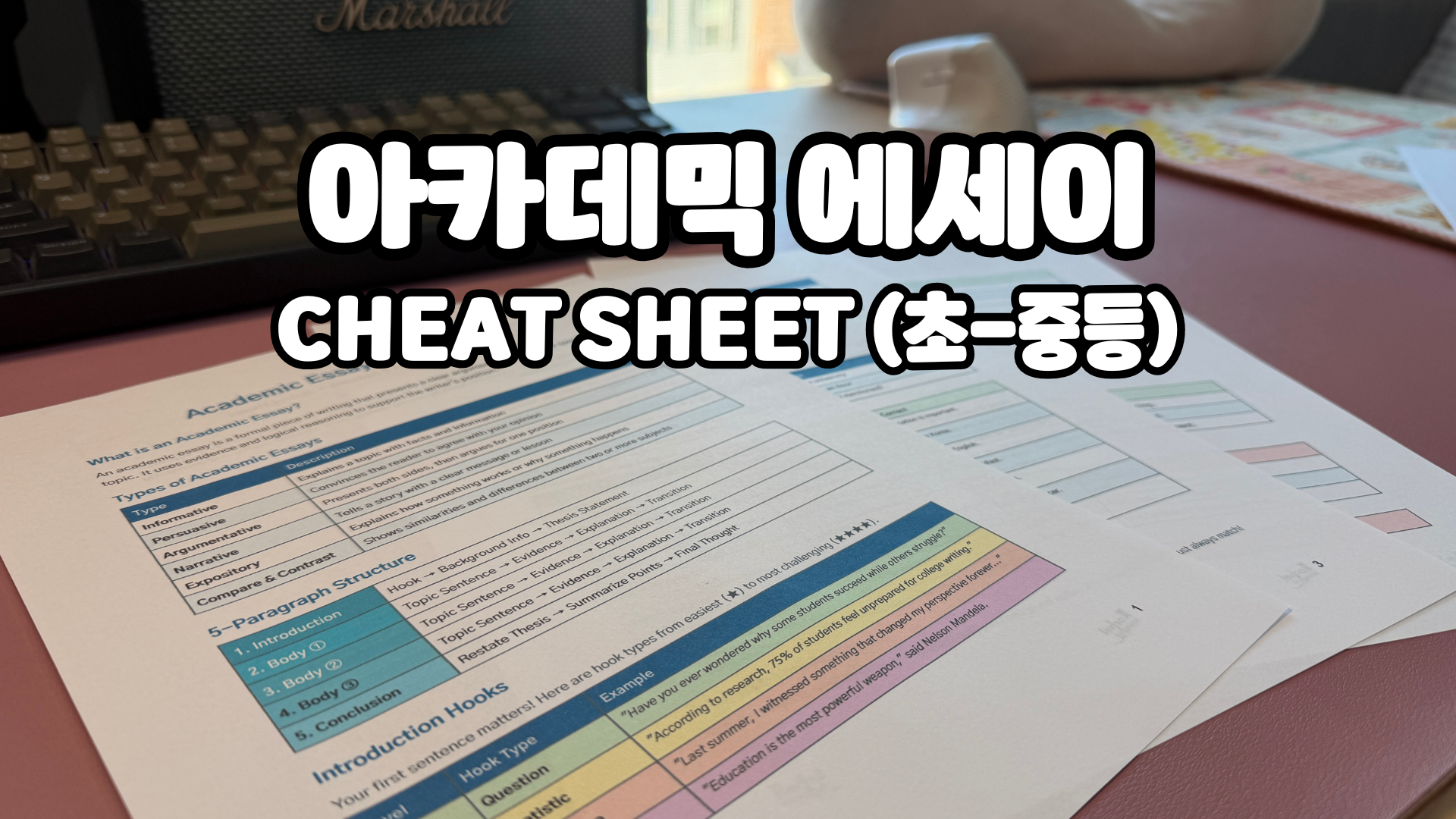
Students need to understand that not all essays are the same. The cheat sheet breaks down six major types of academic essays — Informative, Persuasive, Argumentative, Narrative, Expository, and Compare & Contrast — so students know exactly what’s expected of them before they start writing.
학생들은 모든 에세이가 같지 않다는 것을 이해해야 합니다. 이 치트시트는 여섯 가지 주요 아카데믹 에세이 유형을 설명합니다 — Informative, Persuasive, Argumentative, Narrative, Expository, Compare & Contrast — 그래서 학생들이 글을 쓰기 전에 무엇이 기대되는지 정확히 알 수 있습니다.
It also explains the classic 5-paragraph structure in a clear, visual format: Introduction → Body (x3) → Conclusion. Each section is broken down into its components, so students understand not just what to write, but how to build each paragraph.
또한 고전적인 5문단 구조를 명확하고 시각적인 형식으로 설명합니다: 서론 → 본론 (x3) → 결론. 각 섹션이 구성 요소별로 분해되어 있어서 학생들이 무엇을 써야 하는지뿐만 아니라 각 문단을 어떻게 구축하는지 이해할 수 있습니다.
2. Writing Strong Introductions | 강력한 서론 작성법
The introduction is where most students struggle. They don’t know how to “hook” the reader, and they often write weak thesis statements that merely announce a topic rather than make a claim.
서론은 대부분의 학생들이 힘들어하는 부분입니다. 독자를 “끌어당기는” 방법을 모르고, 주장을 하기보다 단순히 주제를 발표하는 약한 주제문을 쓰는 경우가 많습니다.
The cheat sheet provides four types of hooks ranked by difficulty level — from simple questions (★) to more advanced quotes (★★★★) — so students can choose an approach that matches their skill level.
이 치트시트는 난이도별로 네 가지 유형의 훅을 제공합니다 — 간단한 질문(★)부터 더 고급인 인용문(★★★★)까지 — 학생들이 자신의 실력 수준에 맞는 접근법을 선택할 수 있습니다.
It also includes a clear thesis statement formula: Topic + Opinion + 3 Reasons = Strong Thesis. With good and bad examples side by side, students can immediately see the difference between a compelling thesis and a weak one.
또한 명확한 주제문 공식이 포함되어 있습니다: 주제 + 의견 + 3가지 이유 = 강력한 주제문. 좋은 예시와 나쁜 예시가 나란히 있어서 학생들이 설득력 있는 주제문과 약한 주제문의 차이를 즉시 볼 수 있습니다.
3. Transition Words | 전환어
One of the fastest ways to elevate student writing is through better transitions. The cheat sheet organizes transition words by function — Addition, Contrast, Cause/Effect, and Conclusion — giving students a ready-to-use vocabulary bank for connecting their ideas.
학생 글쓰기를 빠르게 향상시키는 방법 중 하나는 더 나은 전환어를 사용하는 것입니다. 이 치트시트는 전환어를 기능별로 정리합니다 — 추가, 대조, 원인/결과, 결론 — 학생들에게 아이디어를 연결하기 위한 즉시 사용 가능한 어휘 뱅크를 제공합니다.
4. Common Grammar Mistakes | 흔한 문법 실수
This is where ESL-specific guidance becomes critical. The cheat sheet addresses four of the most common grammar issues I see in student writing:
여기서 ESL 특화 지침이 중요해집니다. 이 치트시트는 학생 글쓰기에서 가장 흔히 보이는 네 가지 문법 문제를 다룹니다:
- Articles (A, An, The): A concept that doesn’t exist in Korean, which makes it incredibly difficult for Korean-speaking students. The guide explains when to use each article — and just as importantly, when NOT to use articles at all. | 관사 (A, An, The): 한국어에 존재하지 않는 개념이라 한국어를 모국어로 하는 학생들에게 매우 어렵습니다. 이 가이드는 각 관사를 언제 사용하는지, 그리고 관사를 전혀 사용하지 않아야 할 때를 설명합니다.
- Subject-Verb Agreement: Students often get confused when prepositional phrases separate the subject from the verb. The cheat sheet clarifies this with examples and reminds students which words are always singular. | 주어-동사 일치: 전치사구가 주어와 동사를 분리할 때 학생들이 종종 혼란스러워합니다. 이 치트시트는 예시로 이를 명확히 하고 항상 단수인 단어들을 상기시켜 줍니다.
- Run-on Sentences: Many students mash two complete sentences together without proper punctuation. The guide shows three ways to fix this common error. | Run-on 문장: 많은 학생들이 적절한 구두점 없이 두 개의 완전한 문장을 붙입니다. 이 가이드는 이 흔한 오류를 고치는 세 가지 방법을 보여줍니다.
- Comma Splices: Similar to run-ons, comma splices occur when students use only a comma to join two independent clauses. The cheat sheet introduces the FANBOYS rule as a simple fix. | Comma Splice: Run-on과 비슷하게, comma splice는 학생들이 두 개의 독립절을 연결하기 위해 쉼표만 사용할 때 발생합니다. 이 치트시트는 간단한 해결책으로 FANBOYS 규칙을 소개합니다.
5. Words to Avoid | 피해야 할 단어
Academic writing requires a formal, objective tone — but students often default to casual language. The cheat sheet identifies three categories of problematic words:
아카데믹 라이팅은 격식 있고 객관적인 어조를 요구합니다 — 하지만 학생들은 종종 캐주얼한 언어를 기본으로 사용합니다. 이 치트시트는 세 가지 범주의 문제적인 단어를 식별합니다:
- Overused transitions (And, But, So) with better alternatives | 남용되는 전환어 (And, But, So)와 더 나은 대안
- Vague words (good, bad, thing, stuff, many) with precise replacements | 모호한 단어 (good, bad, thing, stuff, many)와 정확한 대체어
- Personal pronouns (I, You, We) with examples of how to rewrite sentences in an objective voice | 인칭 대명사 (I, You, We)와 객관적인 문체로 문장을 다시 쓰는 방법 예시
6. Conclusion Writing | 결론 작성법
Finally, the guide addresses one of the most overlooked parts of an essay: the conclusion. It provides clear do’s and don’ts, along with a side-by-side comparison of a weak conclusion versus a strong one.
마지막으로, 이 가이드는 에세이에서 가장 간과되는 부분 중 하나인 결론을 다룹니다. 명확한 해야 할 것과 하지 말아야 할 것을 제공하고, 약한 결론과 강한 결론을 나란히 비교합니다.
The Value Inside This Free Resource
If I were to teach all of this material in private lessons, it would take approximately three hours of instruction — at minimum. That’s three hours of explaining concepts, working through examples, and drilling common mistakes.
제가 이 모든 내용을 개인 레슨으로 가르친다면, 최소 3시간의 수업이 필요합니다. 개념을 설명하고, 예시를 살펴보고, 흔한 실수를 연습하는 3시간이요.
If you’re paying $100 per hour for private tutoring (a reasonable rate for experienced ESL writing instructors), that’s $300 worth of content — condensed into a single, printable PDF.
만약 개인 과외에 시간당 $100을 지불한다면 (경험 있는 ESL 라이팅 강사의 합리적인 시세입니다), 그건 $300 상당의 콘텐츠입니다.
How to Use This Cheat Sheet
이 치트시트 활용법
This resource is ideal for students in Grades 4–8 — the years when academic writing expectations begin to ramp up significantly.
이 자료는 4~8학년 학생들에게 이상적입니다 — 아카데믹 라이팅 기대치가 크게 높아지기 시작하는 시기죠.
Here’s how I recommend using it:
권장하는 활용법은 다음과 같습니다:
For Students | 학생들을 위해
Print it out and keep it in your binder or at your desk. Every time you have a writing assignment — whether it’s for English class, social studies, or any subject that requires an essay — pull out the cheat sheet and use it as a checklist.
프린트해서 바인더나 책상에 보관하세요. 글쓰기 과제가 있을 때마다 — 영어 수업이든, 사회 수업이든, 에세이가 필요한 어떤 과목이든 — 치트시트를 꺼내서 체크리스트로 활용하세요.
Before you submit, ask yourself: | 제출하기 전에 스스로에게 물어보세요:
- Did you include a hook? | 훅을 포함했나요?
- Is your thesis statement clear and arguable? | 주제문이 명확하고 논쟁 가능한가요?
- Did you use strong transitions? | 강력한 전환어를 사용했나요?
- Did you check for article errors, run-on sentences, and comma splices? | 관사 오류, run-on 문장, comma splice를 확인했나요?
- Did you avoid vague words and personal pronouns? | 모호한 단어와 인칭 대명사를 피했나요?
For Parents | 부모님들을 위해
If you’ve ever felt unsure about how to help your child with writing assignments, this cheat sheet gives you a framework. You don’t need to be an English teacher to review an essay with your child. Use the guide to ask targeted questions:
자녀의 글쓰기 과제를 어떻게 도와줘야 할지 확신이 없으셨다면, 이 치트시트가 프레임워크를 제공합니다. 자녀와 에세이를 검토하기 위해 영어 선생님일 필요는 없습니다. 가이드를 사용해서 구체적인 질문을 하세요:
- “Can you show me your thesis statement? Does it follow the formula?” | “주제문을 보여줄 수 있니? 공식을 따르고 있니?”
- “What type of hook did you use?” | “어떤 종류의 훅을 사용했니?”
- “Let’s check your transitions — are you using anything other than ‘and,’ ‘but,’ and ‘so’?” | “전환어를 확인해보자 — ‘and,’ ‘but,’ ‘so’ 말고 다른 것도 사용하고 있니?”
Even if your own English is strong, academic writing has specific conventions that differ from conversational or professional English. This guide helps bridge that gap.
부모님의 영어 실력이 좋더라도, 아카데믹 라이팅은 일상 영어나 비즈니스 영어와는 다른 특정한 규칙이 있습니다. 이 가이드가 그 차이를 메워줍니다.

Two Versions Available
I’ve created two versions of this cheat sheet:
이 치트시트의 두 가지 버전을 만들었습니다:
- English Version — Clean, professional, and ready for classroom or home use. | 영어 버전 — 깔끔하고 전문적이며, 교실이나 가정에서 바로 사용 가능합니다.
- Korean-English Bilingual Version — The same content with Korean translations and explanations, perfect for students (or parents) who benefit from seeing concepts explained in both languages. | 한영 이중언어 버전 — 동일한 내용에 한국어 번역과 설명이 포함되어 있어, 두 언어로 개념을 보는 것이 도움이 되는 학생(또는 부모님)에게 완벽합니다.
Choose whichever version works best for your family.
가정에 가장 잘 맞는 버전을 선택하세요.
Comments
9 responses
Thanks a lot.
Your welcome! Please let me know if it was helpful!
Thanks a lot ♥️
Your welcome! Please let me know if it was helpful!
Thank you so much!
Your welcome!
안녕하세요! Writing에 도움되는 유용한 자료 만들어주셔서 감사합니다.
자료를 받고 싶은데 writing cheat sheet 다운로드가 안 되요 ㅠㅠ 파일 링크에 에러가 있는 것 같아서 확인 부탁드립니다.
안녕하세요! 다시 업로드를 해보았는데 이제는 괜찮은지 확인해 주세요.
오!! 네 이제 되요. 다운 받았어요. 감사합니다ㅠㅠ! 자료 잘 쓸게요. 새해 복 많이 받으세요~